



Description
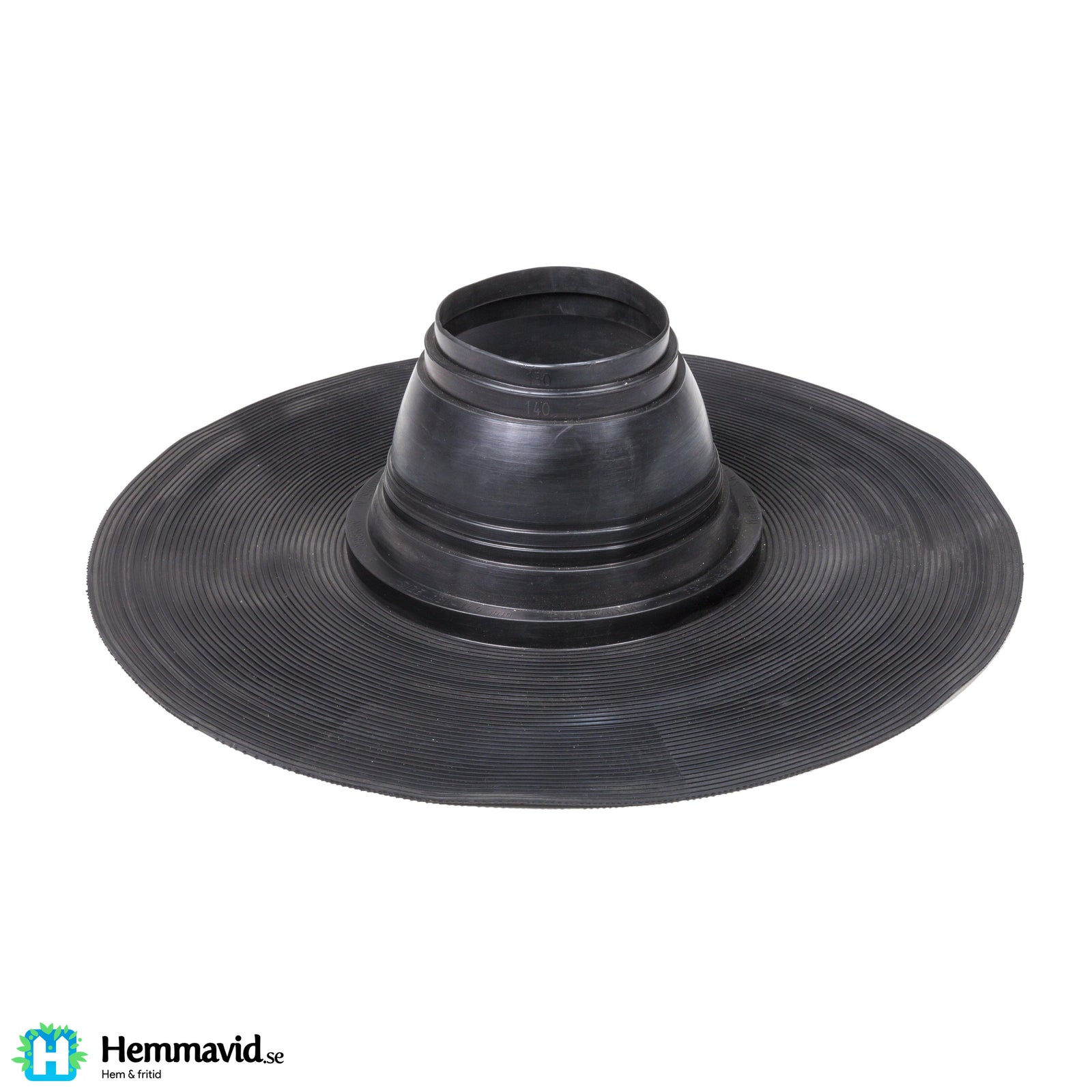
Pipe penetrations for felt roofing
Product description
AIR AND MOISTURE SEALING
Age-resistant EPDM rubber collars with a flange made of either moisture-repellent kraft paper with acrylic adhesive or aluminum foil coated with butyl adhesive (e.g., for horizontal surfaces, roofs). Provided with protective paper that is removed during installation. Range: Round pipe penetrations in various dimensions. Used as internal and external moisture and air seals. For round penetrations in external walls, the Kraft version is used on surfaces such as building foil (air and vapor barrier), vapor retarders, wind shields (T-Vind/-Super), as well as most external wind shield boards, etc. Harmful moisture and steam are prevented from being transported into or out of sensitive building components. Counteracts energy losses in insulated constructions
Sealing of round penetrations is most easily performed within the system using the corresponding collars. The collar will overlap the opening in the membrane and form a tight seal against the pipe or hose. A rubber collar with a self-adhesive butyl underside (acc. to 3:1) is available in various standard diameters. Remove the protective paper under the collar. Press the collar down onto the substrate and fix it in place with a roller. A rubber collar that is not self-adhesive (acc. to 3:2) is installed in the same way but is glued to the substrate using the accessory Butyl Sealing Tape or T-Fix butyl sealant in three beads with completely closed rings. After curing, the outer edge of 3:2 is taped protectively with T-Flex Sealing Tape.
Seal the top of the rubber collar around the pipe/cable with either a hose clamp or Butyl Sealing Tape. It is important to achieve airtightness at the top and bottom of the penetration collar.
Remember
• Surfaces to be taped and sealed must be clean, dry, and free of grease.
• All joints and penetrations must be tight and completely sealed to achieve full functionality in radon protection.
• Use only the accessories recommended in the system as joint sealing aids.
• Installation should be carried out at temperatures that favor the application of jointing aids such as tape, butyl sealant, and collars. In cooler weather (<10 °C), store all included products in a warm place before installation. Heat
carefully with a heat gun during application if necessary. At temperatures <5 °C, supplement the sealing of the
joint with butyl sealant.
• Before installation/covering, the membrane should be inspected for damage. These must be repaired and sealed with jointing aids and/or any necessary patch of the membrane.
• Use on moisture-prone substrates (such as concrete) should be dimensioned according to their moisture content. The membrane
exhibits sealing properties equivalent to a so-called Moisture Barrier (see reported vapor transmission resistance) and should
be used accordingly.
• Ensure that any fill material above the membrane is radon-free.
• If there is uncertainty regarding radon measures or moisture problems in the foundation, contact an expert for consultation.
• The products should be stored protected from sunlight and precipitation and at a normal storage temperature.
• After installation, all included products in the system should be built into the construction as soon as possible, protected from
sunlight (-UV) and precipitation.
Specifications
Specifications
Data sheets
Technical data sheet:
Safety data sheet: