

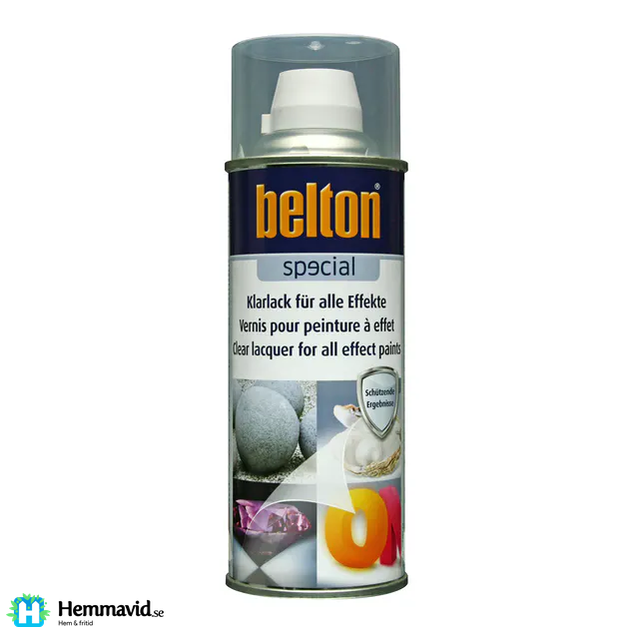


Description
The perfect protection – for all surfaces and effects
Belton Special Clear Coat is the obvious final step for a professional and durable result. Whether you are coating wood, metal, glass, ceramic, or plastic – the clear coat provides a brilliant shine and effective protection against chemicals, moisture, and everyday wear and tear. Very fast-drying and easy to work with, straight from the can.
Product description
Area of application Universal protective lacquer for wood, metal, stone, glass, ceramic, clay, paper, and most plastic materials. Used as a finishing coat for Belton Special effect paints.
Coating structure
- Belton Special effect paint
- Belton Special Clear Coat for all effects
Application Shake the can well before use. Hold the spray 15–25 cm from the surface and apply 2 cross-coats for the best result. Always perform a test spray first to check for compatibility and appearance.
Specifications
- Very fast-drying – dust-dry after 20 min
- Brilliant shine
- Good chemical resistance
- Free from CFCs
- Free from heavy metals – lead, cadmium, and chromium
- Acrylic resin base
- 400 ml
Drying times
- Dust-dry: after 20 minutes
- Hard-dry: after approx. 12 hours
- Recoatable with itself: at any time
- Recoatable with other Belton paints: at any time
Technical data
- Base material: Acrylic resin
- Film thickness: approx. 30–40 µm after 2 cross-coats
Important points to consider
- Do not spray on surfaces treated with synthetic resin – the lacquer may lift
- Turn the can upside down after use and spray the valve empty.
FAQ
Which surfaces is the clear coat suitable for? Wood, metal, stone, glass, ceramic, clay, paper, and most plastic materials. Also works as a protective lacquer for all Belton Special effect paints.
How fast does it dry? Dust-dry after 20 minutes and hard-dry after approx. 12 hours.
Can I paint over it with other colors? Yes, the clear coat can be recoated with itself and other Belton paints at any time.
Is it environmentally friendly? Yes, it is free from CFCs as well as heavy metals such as lead, cadmium, and chromium.
Are there any surfaces I should not use it on? Avoid surfaces treated with synthetic resin – the lacquer may lift.
How many coats are needed? 2 cross-coats provide a film thickness of approx. 30–40 µm and an optimal result.
Data sheets
Technical data sheet: Download
Safety data sheet: Download